Tuesday, March 31, 2015

Retrieve an average number of chars in XML column in DB2


In case if you have an XML column content in your youtTable and you want to count an average number of characters (or min, max) in the column you can use this code. 
  1. set schema yourSchema;
  2. SELECT avg(xtab.length) 
  3.    FROM URCH_POSTS, 
  4.        XMLTABLE(     
  5.           'for $i in $c 
  6.         let $len := fn:string-length($i)
  7.       return {$len}'
  8.       passing youtTable.content as "c"
  9.       COLUMNS 
  10.               length INTEGER PATH '.')  
  11.                                                            as xtab;
In 4th line we are starting to create a XMLTABLE
In 5th line we start an XQuery (') for loop over every line of $c where $c is defined in the line 8 (just a value from you column)
In 6th line we define our return value. It should be in the XML form. And finish our XQuery (')
In 9th line we start to define columns that will be returned in the XMLTABLE
In 10th line we name our column length, define its type INTEGER and the path in the resulted from the line 7 XML string. 
In the 11th line we name the output
In the 2nd line we retrieve the output as an INTEGER column and therefore we can run corresponding operations. 

One can  refine the code by calculating the average in the XQuery directly using fn:avg

Friday, July 4, 2014

Patterns of users/communities/media in the Web: list of papers

Hi,

i want to share a list of papers that are observing user traces in the Web and extract patterns from these. You can add your/other papers by commenting + i am updating the list. The citation style is not consistent and i'm not guaranteeing that citations are 100% correct (pages, proceedings, etc). If you use them please check and let me know if anything is wrong.

I add as well some comments about the papers.

The last but not least, good luck with your research.


  • 2006
    • Danyel Fisher, Marc Smith, and Howard T. Welser. 2006. You Are Who You Talk To: Detecting Roles in Usenet Newsgroups. In Proceedings of the 39th Annual Hawaii International Conference on System Sciences - Volume 03 (HICSS '06), Vol. 3. IEEE Computer Society, Washington, DC, USA, 59.2-. DOI=10.1109/HICSS.2006.536 http://dx.doi.org/10.1109/HICSS.2006.536

      The authors define a question-answer person
       that is characterized by responding to those with low out-degree and infrequently responding to those with higher degree. Depending on a forum topic, the behavior of its users differentiate. Forums devoted to hobby topics admit outsiders though they have cores. While in flame forums people are replying only to well-connected users.
    • Ralf Klamma, Marc Spaniol, and Dimitar Denev. PALADIN: A Pattern Based Approach to Knowledge Discovery in Digital Social Networks. In Proceedings of I-KNOW ’06, 6th International Conference on Knowledge Management, Graz, Austria, September 6 - 8, 2006, J.UCS (Journal of Universal Computer Science) Proceedings, pages 457–464. Springer, 2006.

      Focus of this paper is to create a pattern language that describe patterns of digital traces in Web. After analyzing mailing lists, authors find patterns like no answering person, spammer and troll based on patterns they described with the language.
  • 2009
    • R. Dean Malmgren, Jake M. Hofman, Luis A.N. Amaral, and Duncan J. Watts. 2009. Characterizing individual communication patterns. In Proceedings of the 15th ACM SIGKDD international conference on Knowledge discovery and data mining (KDD '09). ACM, New York, NY, USA, 607-616. DOI=10.1145/1557019.1557088 http://doi.acm.org/10.1145/1557019.1557088

      The authors define a model that describe communication patterns (e-mail communication of students); find that users do not change their behaviors over semesters (their belonging to initial clusters are stable) while they differentiate between each other. 
    • Meeyoung Cha, Juan Antonio Navarro Perez, and Hamed Haddadi Flash Floods and Ripples: The Spread of Media Content through the Blogosphere. In Proc. of the AAAI Conference on Weblogs and Social Media (ICWSM) Data Challenge Workshop, San Jose, May 2009

      The paper investigates patterns of content diffusion by investigating blog networks. Most of blogs (70%) produces only 30 % of the content. While other blogs serve like mass media. These are community-edited blogs, spammed blogs, microblogging blogs and content aggregators. Two types of content spreading was defined: flash floods like news which quickly distribute but did not appear later and ripples which can be discovered a long time after appearing, like songs.
    • Fabrício Benevenuto, Tiago Rodrigues, Meeyoung Cha, and Virgílio Almeida. 2009. Characterizing user behavior in online social networks. In Proceedings of the 9th ACM SIGCOMM conference on Internet measurement conference (IMC '09). ACM, New York, NY, USA, 49-62. DOI=10.1145/1644893.1644900 http://doi.acm.org/10.1145/1644893.1644900

      User activities with social networks reveal more often user activities in SN. Moreover sequence of activities were investigated as well to find out when and why users perform some actions, like viewing pictures. 
  • 2012
    • Claudia Wagner, Matthew Rowe, Markus Strohmaier, and Harith Alani What Catches Your Attention? An Empirical Study of Attention Patterns in Community Forums. . ICWSM, The AAAI Press,

      The study focuses on LDA (Latent Dirichlet Allocation) application on investigating forum texts. The authors consider user, focus, post, title and community features to find the most relevant features for each community. They discover differences in features' significance depending on communities. For example, in communities with no specific topics a post should be short to increase a probability to be answered. While in communities with specific topics newbies get replies quiet often.
    • Hillmann, R.; Trier, M. Dissemination Patterns and Associated Network Effects of Sentiments in Social Networks 2012 IEEE/ACM International Conference on Advances in Social Networks Analysis and Mining (ASONAM) 

      The authors consider Web communities according to dynamic network motif analysis. They find network patterns like reciprocity (bi-directional connection) and transitivity (a friend of my friend becomes my friend) in BBC and Digg forum discussions. But emotions, positive and negative, expressed in textual messages have no impact on these classical network patterns.
    • Cha, M., Benevenuto, F., Haddadi, H., and Gummadi, K.  The World of Connections and Information Flow in Twitter. Systems, Man and Cybernetics, Part A: Systems and Humans, IEEE Transactions on 42, no. 4 (2012): 991–998. 

      The authors divide Twitter users onto three groups: grassroots, evangelists and mass media. The division was done according to the indegree of the users. After that, these users were described, e.g. reciprocity, appearance in events, etc. One of the statement of the paper is that evangelists extend the reach of mass media up to 25 %. 
  • 2013
    • Kizilcec, René F., Piech, Chris, and Schneider, Emily. Deconstructing disengagement: analyzing learner subpopulations in massive open online courses. 2013. http://doi.acm.org/10.1145/2460296.2460330.

      The main focus of the paper to find patterns of learner engagement in Massive Open Online Courses. Authors use demographic, forum activity, overall experience and some other information for detecting clusters and explain user disengagement by consideration of particular classes.
  • 2014
    • Ashton Anderson, Daniel Huttenlocher, Jon Kleinberg, and Jure Leskovec Engaging with massive online courses. In Proceedings of the 23rd international conference on World wide web (WWW '14). International World Wide Web Conferences Steering Committee, Republic and Canton of Geneva, Switzerland, 687-698. DOI=10.1145/2566486.2568042 http://dx.doi.org/10.1145/2566486.2568042 

      Here activities of users in MOOCs were analyzed. The authors define patterns of users trivially by a number of lecture viewing. Later grades of users were compared with viewing of lectures and participating in forums. Two types of users are submitting assignments: hard working students that are engaged in a course all the time and students that have a knowledge of the course and just submit its assignments. Forum participants are mostly consist of forum users. In forum threads users who answer threads are those who are more active in the forum than initiators of the threads. Or are those who have higher grades.
       

Friday, February 28, 2014

Overview of community evolution research (1)

The earliest published work i found about the phases of community evolution belong to Toyoda and Kitsuregawa from University of Tokyo. They differentiate between phases of community evolution: emerge, dissolve, grow and shrink, split, and merge. They use Japanese web archives to prove their rules for each of the evolution phase.  They use an extension of HITS to detect communities.

Later Palla and colleagues present their seminal work with beautiful visualization of different phases that i will add here.
Greene et al. and Gliwa et al. play with same or similar phases using Jaccard Index to define the changes that indicate the move of a community from one phase to the other.

Other research directions investigate community evolution and find feature sets that predict length of community life and its growth [1-5].

But some facts about community evolution still stays unclear: 1) how can one characterize the stages of community life-cycles? 2) what are the changes of community content during its evolution?

Later i will post some results of my research work that answer these questions.

1. L. Backstrom, D. Huttenlocher, J. Kleinberg, and X. Lan. Group formation in large social networks. In
the 12th ACM SIGKDD international conference, pages 44-54, New York and NY and USA, 2006. ACM.

2. S. R. Kairam, D. J. Wang, and J. Leskovec. The life and death of online groups: predicting group growth
and longevity. In the Fifth ACM international conference on Web search and data mining, pages
673-682, 2012.

3. M. K. Goldberg, M. Magdon-Ismail, and J. Thompson. Identifying Long Lived Social Communities Using
Structural Properties. In IEEE/ACM International Conference on Advances in Social Networks Analysis
and Mining (ASONAM), pages 647-653, 2012.

4. A. Patil, J. Liu, and J. Gao. Predicting Group Stability in Online Social Networks. In Proceedings of
the 22nd International Conference on World Wide Web, WWW '13, pages 1021{1030, Republic and
Canton of Geneva and Switzerland, 2013. International World Wide Web Conferences Steering Committee.

5. E. Zheleva, H. Sharara, and L. Getoor. Co-evolution of social and a liation networks. In Proceedings of the 15th ACM SIGKDD international conference on Knowledge discovery and data mining, KDD '09, pages 1007-1016, New York and NY and USA, 2009. ACM.

Thursday, January 30, 2014

XML validation / XSL transformation in Eclipse

Here i share with you how to validate XML or XSLT output with the help of Eclipse.

First of all, check if you have XSL Developer tools. If not, just install new software (Help->Install New Software) and choose XSL Developer tools.

To check if the XML is valid you need to add the XSD schema to the code and check if it is in the XML Catalog (Windows->Perspective->XML->XML Catalog). After you add/find the schema in the catalog, just click the right button on the file and choose Validate.

The alternative is to select all files (XML, XSD) and choose Validate (from the right click menu again).

To check the output of the XML file applying XSLT you need to run the XSL transformation of the XSL/XSLT file and choose the file under which you want to run the transformation.

Notes:
if you need to validate xhtml website use the following attributes in the html tag
xmlns="http://www.w3.org/1999/xhtml"
xmlns:xsi="http://www.w3.org/2001/XMLSchema-instance"
xsi:schemaLocation="http://www.w3.org/1999/xhtml
http://www.w3.org/2002/08/xhtml/xhtml1-transactional.xsd"

The screenshots will be added.

Friday, December 20, 2013

A Datawarehouse for Social Media for Learning


Recently i started to redesign our Mediabase, the database that includes data crawled from social media. A data warehouse model is more convenient for analyzing social media. Here i'm going to explain why.

All in all, the Mediabase design is not wrong. Behind it, its creators put the actor network theory (ANT) that claims all items in a system as actors. The following picture will help to understand how this idea applied to the Mediabase.


The Mediabase was an empty database with set of defined tables. Now it is filled on a regular basis with the help of watcher scripts. A watcher crawls one of Media: blogs, feeds, podctasts, e-mail archives. The traces left in a medium by its users consist of texts, tags or labels, urls and many other components. We collect these Artifacts in the Mediabase to be able later to apply them for different analytic tasks. Moreover, we examine users, e.g. e-mail senders, blog owners, forum posts authors and others. We can apply different analysis investigating changes of behaviors of uniquely defined users. Such an analysis shows activity patterns of users, their roles in communities, their interests and their closed peers in networks.

The Artifact and Medium are actors according to the ANT. The Community, the Agent (or User) and the Process are actors as well. All they have an influence on activities in online networks. That is why the Mediabase aim is to capture these changes.

But why do we need to collect all these data? Let us follow a teacher that aims to understand what problems do students have by solving an exercise. He can try to find an answer by observing online student communities and finding answers to the following questions:
  • Are there any questions about the exercise?
  • How many people have viewed the topic?
  • How many people have took part in the discussions?
  • What resources were used? How active are the students that talk about the exercise?
  • What are the sentiments and intents expressed in the discussions?

To find the answers can be time-consuming and impossible manually (depending on the number of students and the number of involved online communities). 1) Communities have unique structures: the positions of users in structures specify roles that represent community experts, communicative members and brokers which are members connecting several groups. 2) Huge amount of texts include relevant and irrelevant for learning information. It may include interesting explanations and links but can be overlooked by a person.

So the help of machines is needed not only because the communities are big. We are talking about situations when teachers, managers or stakeholders of online learning communities want to get answers to different questions about different time intervals of their communities.

Therefore, we need a database model that provides the right information in the right place at the right time with the right cost in order to support the right decision. In the traditional databases we get a data item by specifying two parameters, e.g. specifying the time and the medium parameters we get posts appeared in the medium in the given time period. Or we get users that were active at the given time period in the given medium. But more sophisticated queries require some time to execute because of joins, etc. Moreover, analyzing communities researchers have to mine data and afterwards make some experiments to find patterns.

To simplify the life cf researchers, I propose a data cube that is a multidimensional model with a set of measures - facts. We can navigate over the data cube by specifying dimensions that correlate with Actors of ANT model. Particularly, we can choose a User that posted at a Time in a Medium so that we get the output that characterize the User in the given Time point in the given Medium. But in this case the output includes different measures captured by mining social networks, texts or user activities.

On the following picture you can see the hierarchy of dimensions to the proposed data cube. The construction of the Mediabase cube is still not ready, as it should reflect all actors we find important in the online networks. Thus I still need to elaborate Process, Agent(types), Community(types), Artifacts dimensions.

Thursday, September 5, 2013

Motivation for Life Long Learning

Recently i read nice report about the Future of Learning. Here are some thoughts i got during reading this nice piece.

In 2020 European society will require 16 millions more qualified workers than in 2010. Moreover, to stay competitive in crisis and technological changes, European society need to grow the number of university graduates. In the time of globalization Europe can not compete with growth of China or India economies. Therefore, Europe need to find ways to save its share of the global wealth through the excellence and innovations.

The number of older people is growing and the number of younger people decreases. The labor force is aging and half more people over 65 than now.will live in 2050. Therefore, older people need as well to have opportunities to improve their knowledge and increase qualification degrees.

Europe attracts immigrants to get enough labor force. Even so immigrants usually stay unemployed that indicates the need of immigrants and their children to be supported in education and orientation in new country.

Significant impact of technology is/will change job structure and requirements. It dictates new skills required for jobs, in most cases ICT skills. We can acquire new skills in schools, universities, at training and workshops. However, costs and requirements of rapid learning from the industry increase the preferences for virtual way of learning.

  • In the future immigrants and their children can learn languages in the country where they immigrate on fly using ubiquitous computing. 
  • In the future aging workers may acquire new skills at working place and stay professionally fit. 
  • In the future people with medium or high qualifications but obsolete professions can apply their skills for other kinds of job. 
  • In the future people with low qualification can study and learn new jobs staying at home.
Virtual learning influence not only which way we learn but how we learn. The learning becomes self-oriented, collaborative and open to the society.


Friday, July 5, 2013

Data Warehouse in Simple English

If you need ''the right information in the right place at the right time with the right cost in order to support the right decision''[1] from , the data warehouse comes into play. So what does right information mean? The knowledge workers, like accountants, project managers and data analysts, need a support to make decisions and data warehouse provide such a support for all types of knowledge workers on the same data.

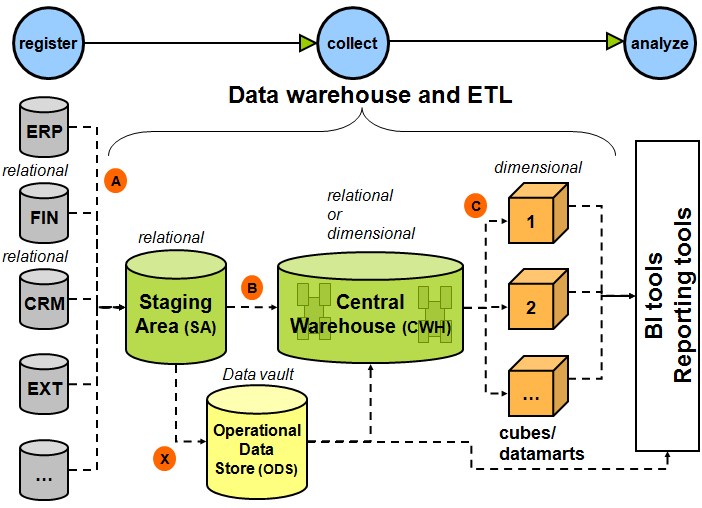
How do the developers manage to use same data and support different tasks? I know two classical approaches to design a data warehouse: top-down and bottom-up approaches. In the top-down approach [2], all the data and its statistics are stored and parts of it are copied in data marts (pieces of data) for the further use. The approach is time-consuming and costly as by designing a data warehouse model one have to reconcile structure of sources. The bottom-up approach [3] is less costly and focus on creating rapid solutions with less redundant data and small data marts. But the approach consider just one or a few tables that are fact tables and include integrated data from data sources while all other data land in data marts. The flaw of the bottom-up approach lies in its inflexibility according to the changes of requirements of data warehouse users.

In the top-down approach you extract the data, cleaned it, transformed it according to your schemata and uploaded into the global warehouse. You can use some pieces of the data for some statistics (in Operation Data Store for example) but generally all data you need to use for the applications (Data mining, Data visualization, Planning, Prediction) you copied in additional data marts. A good example of this design is taken from http://datacommanders.com/


In the bottom-up approach after the extraction and transformation of the data, you store it in global warehouse as following: one or several fact tables and its dimensions - so global warehouse information model looks like a star.
A good example of it taken from the www.databaseanswers.org
[2] William H. Inmon(1996). Building the Data Warehouse. John Wiley & Sons, ISBN
[3] Ralph Kimball (1996). The Data Warehouse Toolkit. Wiley.


Tuesday, May 28, 2013

Deleting duplicates in the DB2 with the IBM Control Center

Sometimes you have to do just a small task on the database and if you don't have/want to use a command line, you can use an interface like the Control Center.

If you have tables with duplicate values in the DB2 and the tables have primary keys, let say ID, it is easy to avoid the duplicates.

First copy the table. Use the

create table message_table_copy ...

query and check that all fields you want to copy have the same types. 

Than you can load the data into the message_table_copy. The table from which you are coping and the table to which you are coping, in this case  message_table and message_table_copy should belong to the same schema. Choose Load (right-click menu) -> Add data -> from cursor. Than you can choose the data you want to copy (Select * from message_table if you copy the whole table) and the folder where the status information have to be stored (usually on the server, so choose the home directory of your db2 instance on the server). All other tabs are default except of the tab where you have to choose to perform the task immediately or to add in the task manager.

Now you can check if all values were copied. You can just count the number of entries in both tables:

select count(*) from message_table 

If everything is ok, look for duplicates. Let say, you have message_id which should be used to define duplicates. Here is the SQL query to delete the duplicates from the message_table

delete from message_table where id in 
          (SELECT MIN(ID) FROM message_table
                          GROUP BY message_id 
                          HAVING COUNT(message_id) >1) )

The query searches for entries with same message_id (INT, SMALLINT, BIGINT) and chooses the id ( you can choose between MAX(id)/MIN(id)) that is used for deleting.

Wednesday, September 26, 2012

Users editing articles in several Wikipedia

I was wondering about contributors who are posting in several Wikipedia, Who are they? What country are they from?

Surely English Wikipedia is a leader in the number of contributors, articles, articles edits and number of users who contribute both in English and any other Wikipedia is high. I never doubt it. What about other Wikipedia? Looking at Wikipedia we can find which nations interact more often with each other than others.

A bit more than 1% of all contributors from our data set editing/creating articles in 2 Wikipedia. Only 12 of 4,919,026 users have ever worked in 5 Wikipedia.


Most of the cross-Wikipedia authors are registered; therefore, we cannot identify the place where the authors come from. A majority of the cross-Wikipedia anonymous authors are coming from Germany (15%) and the United States (11%)


The cross-Wikipedia authors contributing to more than 3 Wikipedia are summarized in following table. 


We find 1,718 contributors that did 618,584 edits. In the table we summarize the contributors work: the number of edits and the number of edits per cross-Wikipedia user. Cross-Wikipedia users contributing in 3 Wikipedia, are participating often in Russian, Japanese and any other Wikipedia from the set. The highest activity (more than 100 edits per cross-Wikipedia user) was shown in Macedonian, Russian, Catalan and Arabic Wikipedia instances. Generally cross-Wikipedia users are more active than contributors working only in one Wikipedia.

Data set:


We analyzed the Wikipedia data starting from June, 30th 2001 till January, 1 2009 and divide this time into 16 equal time intervals to keep visualizations simple. The period of the 1st interval is from June 30th, 2001 till December 31st, 2001, the period of the 2nd interval is from January 1st, 2002 till June, 29, 2002 and so on. Because of hardware limitations, we did not consider all revisions done in the period for constructing author networks. As Wikipedia instances have different number of articles, we choose a number of revisions depending on the number of all revisions in the instances. The revisions are picked up along an article timeline. The overall structure of the Wikipedia network and activities of Wikipedians are not impaired by this data reduction. Finally, we got datasets with number of revisions comparable to each other.

We chose both European and Asian Wikipedia. The instances were selected according to their size: large European Wikipedia (Spanish and Russian), large Asian Wikipedia (Japanese and Turkish), small European Wikipedia (Bulgarian, Catalan, Danish, Greek, Macedonian, and Ukrainian) and small Asian Wikipedia (Arabic, Hindi, and Korean). The list of small European Wikipedia list includes Wikipedia of different Slavic languages (Bulgarian, Macedonian, Ukrainian) and the Catalan Wikipedia, the Wikipedia of a minority language group in Spain.

Monday, August 20, 2012

Cultural analysis of Wikipedia


I'm working under the paper devoted to cultural differences in Wikipedia. Therefore, i have done some literature research where i found some interesting resources devoted to this topic. Following I'm sharing them with you. 
Wikipedia has been found in early 2001 and since then has been one of the most successful and referenced source of knowledge with a qualitative information[1]. The open Encyclopedia can include opinions of any person wherever she geographically located. Wikipedia is organized in such a way that any culture can open its Wikipedia and use its own language for providing content.
According to Hofstede (1991) "culture is the collective programming of the mind which distinguish[sic] one group of people from the other"(Hofstede, 1991). Cultural patterns together create a complex culture structure that can be examined through studying cultural dimensions (Hall, 1976; 1983; Hofstede, 1991; Kluckhohn and Strodbeck 1961; Trompenaars & Hampden-Turner, 1998). Hofstede defined 5 dimensions of culture and calculate empirically dimension rates of many nationalities in the World. The dimensions has become recently a standard framework for cross-cultural research projects. Some works about Wikipedia cross-cultural nature use Hofstede’s dimensions. Courtesy behaviors in the Eastern Wikipedia are explained by high value of power distance and preferable collective work (Hara et al., 2010).  They claimed that authors from Western Wikipedia have more conflict and disagreement behaviors. Moreover, they argue that patterns of author behavior differ in the size of Wikipedia. They analyzed only 4 Wikipedia of various sizes focusing on differences between eastern and western cultures.
Hofstede’s dimensions were used in measuring the quality of the article game (Pfeil et al., 2006). The researchers analyzed the Wikipedia article from French, German, Japanese and Dutch Wikipedia. They found that even if cultures have positively correlated Hofstede's dimensions, Wikipedia quality criteria of considered Wikipedia are different. More evidence of cultural influence in Wikipedia was found by Pembe & Bingol (2006) during comparing linguistic structures of English and German Wikipedia. Although the English Wikipedia is larger; the German Wikipedia included at that point more words associated with family concept.
Rask (2007) analyzed differences between aspects of Wikipedia in developed and developing countries. He considered the number of contributors and edits per articles from different countries and concluded that richer countries profit more on the knowledge shared in Wikipedia. Rask compared different Wikipedia from the economical point of view using the human development index[2] in his observations.
The attempts to define cultural patterns include examination of Wikipedia user talks and talk contents, contents of articles and numbers of edits. In this paper we focus on a still untouched area for cultural patterns in Wikipedia. We observe author networks over the course of time and differentiate between registered and anonymous authors. Moreover, the geographical location of authors and their migrations to other countires is taken into consideration. Furthermore, we find Wikipedia users contributing to several Wikipedia and analyze their behavior and geographical location. These and other findings devoted to Wikipedia growth and editing behaviors are used to define cultural patterns.
Voss (2005) was the first who as many other researchers analyzed fundamentals of Wikipedia and their networks. His main focus was on the German Wikipedia and its graph of links. He showed that the Wikipedia network is scale-free (Barabási et al., 1999). Moreover, Voss found that the number of user talk pages is much higher in Japanese than in German, Danish or Croatian Wikipedia although he left questions concerning cultural differences of Wikipedia unanswered. 
In the next section, we consider name existing research works examining Wikipedia networks. Later, we present our methodology, and afterwards explain the data set we are using. The results include findings about authors, their behaviors, author networks, and articles. The paper concludes with a discussion and an outlook on future work. 

Dynamic development of Wikipedia network

Dynamic development of networks was in the focus by many works (Klamma and Haasler, 2008a, 2008b; Capocci et. al, 2006, Zlatic et. al, 2006). Klamma and Haasler (2008a, 2008b) visualized different Wiki projects (Berlin Wiki, Google Wiki, Aachen Wiki) and observed their changes over the course of time. They found that registered users often serve as connectors in networks of anonymous users. Moreover, they showed that a tiny number of Wikipedia contributors created or edited the majority of articles. Klamma and Haasler created Wikiwatcher tool that can be used for retrieving Wikipedia data, visualize their networks and calculate simple SNA values.
Analysis of Wikipedia as complex networks reveals that the growth of Wikipedia happens according to the preferential attachment (Barabási et al, 1999). Capocci et. al, (2006) showed similarities of evolution patterns of complex networks of WWW and different Wikipedia: new nodes are more probably connected with existed nodes with high degrees of connections. Zlatic et. al (2006) examined 11 Wikipedia networks of articles. The researchers concentrated on article network measures and its comparison. They argue that the growth of Wikipedia networks is unique for different language versions of Wikipedia.

References:
Barabási, A.-L., Réka A., Hawoong J. (1999): Mean-field theory for scale-free random networks.
Hall, E.T. (1976). Beyond culture. Garden City, New York: Doubleday.
Hall, E.T. (1983). The dance of life. Garden City, New York: Doubleday.

Hara, N., Shachaf, P., & Hew, K. (2010). Cross cultural analysis of the Wikipedia community. Journal of the American Society of Information Science and Technology, 61(10), 2097‐2108.
Hofstede, G.H. (1991). Cultures and organizations: Software of the mind. London: McGraw Hill.
Kluckhohn, C., & Strodbeck, F.L. (1961). Variation in value orientation. Evanson, IL: Row and Peterson.
Pembe, F., & Bingol, H. (2006). Complex networks in different languages: A study of an emergent multilingual encyclopedia, Proceedings of Sixth International Conference on Complex Systems, June 25-30, 2006, Boston, MA, USA.
Pfeil, U., Zaphiris, P., & Ang, C.S. (2006). Cultural differences in collaborative authoring of Wikipedia. Journal of Computer-Mediated Communication, 12(1), article 5.
Rask, M.(2007), The Richness and Reach of Wikinomics: Is the Free Web-Based Encyclopedia Wikipedia Only for the Rich Countries?. Proceedings of the Joint Conference of The International Society of Marketing Development and the Macromarketing Society, June 2-5, 2007. 

Trompenaars, F., & Hampden-Turner. C. (1998). Riding the waves of culture: Understanding cultural diversity in global business. New York: McGraw-Hill.
Voß, J. (2005). Measuring Wikipedia, Proceedings of the 10th ISSI 2005 Conference, July 24-28, 2005, Stockholm, Sweden, 1-12.

Wednesday, July 25, 2012

some notes during reading "Networks, Crowds and Markets" by David Easley and Jon Kleinberg - Introduction

a network is a pattern of interconnections among a set of things

adding resources in a network can undermine its efficiency - Braess's paradox

a notion of equilibrium - a state that is self-reinforcing in that it provides no individual with an incentive to unilaterally change his or her strategy, even knowing how others will behave

we have a fundamental inclination to behave as we see other to behave: 1) the behavior of others convey the information or it is a direct benefit from aligning your behavior with that of others

in many cases you care more about aligning your own behavior with the behavior of your immediate neigbors  in the social network, rather than with the population as a whole.

a new behavior starts with a small set of initial adopters and then spread radially outward through the network.

a diffusion of technologies can be blocked by the boundary of a densely connected cluster in the network- a "closed community" of individuals who have a high amount of linkage among themselves, and hence are resistant to outside influences,


Tuesday, July 24, 2012

Things to learn about didactics - need to know for teachers and students

A month ago i was participating in the workshop organized by IMA, ZLW & IfU. The aim was to develop the concept for the interdisciplinary learning event. I suppose that this group was working mostly on the preparation of the workshop.

It was a great event. Just think that we plan a learning discipline with about 15 people where students were involved to!


I hope the event will take place at the summer term. Different departments should participate in it: databases and information systems, business administration, sociology, and product engineering. Therefore, before we start to conceptualize the event, we listened to some didactic tips that many of us know but forget. 


methods for learner interactions:

  • think-pair-share (think alone, talk about it with a partner and present to others)
  • buzz groups (lecturer provides some information and asks a question, the group is formed and the question is discussed in the group, the solution is presented to others)
  • jigsaw (the same procedure as in previous cases but group formation is different. all experts of topics are distributed in groups, so that each group has an expert of each topic)

Memory:

  • ultra short-term memory may give the information to the next memory if it is interesting. According to different sources it works  from 2 to 20 seconds.
  • short-term memory can work till 20 minutes and send the information to the next memory if it is interesting. The capacity is limited in 7 entries (formulas, parameters, words, sentences - depends on how good a mind is trained). The capacity can be extended. 
  • long-term memory stores the information for a long time. There are episodic (when did it happen?), declarative(general) and procedural memory (how did it happen?). BUT the information can be lost!!!
How can you prevent to loose the information from the long-term memory? 
  • repeat the learned material by and by
  • repeat the material in continuously increasing time intervals  
  • 5 minutes pause after the learning block


Tuesday, July 17, 2012

Cultural dimensions of Hofstede


I'm working on one paper devoted to cultural differences in Web and find cultural dimensions of Hofstede extremely important for those who are looking for cultural differences. Here i'm sharing my findings. 

"The great work of Hofstede proposes cultural dimensions of people working at IBM in over 50 countries (Hofstede, 1991). He identified 5 dimensions of differences between national cultures: power distance, collectivism versus individualism, femininity versus masculinity, uncertainty avoidance, long-term orientation. Following we are going to explain these dimensions.
The acceptability and expectance of the power of members within society institutions like family, school and a community at work shows the power distance of the society. This dimension is about respect according to the distance between people in different levels of hierarchy.
Everyone is responsible for herself in individualistic culture while groups are responsible for their members in collectivistic culture. In other words, individualism describes the situation when a person thinks firstly about his interests as long as collectivism describes the situation when a person thinks firstly about group interests.
Masculinity and femininity refer to social gender roles. Either the roles are clearly distinct, i.e. “men are focused on material success, whereas women are concerned with the quality of life” – masculinity is higher. Or the roles overlap, i.e. both women and men take care about life quality and material success.
The attitude to the uncertainty is reflected in uncertainty avoidance (UA) dimension. Representatives of some cultures react negatively to uncertainty and need clear idea about what is going to happen. These cultures have a high level of UA dimension.
Long-term vs. short-term orientation in life explains cultural differences in spending and saving money and accepting quick results. People with long-term orientation of life (LTOL) use to save more money and adopt themselves to the modern context while people with short-term orientation use to overspend but respect traditions without any or with minor adaptations. Moreover, in the first case results should be immediate while in the second case it is very preferable." 

Thursday, June 28, 2012

Recently i was participated in annual Joint Technology Enhanced Learning Summer School that was full of interesting people and great presentations. I managed to talk with some lectures about my dissertation and i'm thankful for such a great opportunity. Now i fill up with new ideas and solutions to the problems i have.

Anyway here i would like to share with slides i was asked to do in the frames of student activities: "Presentation skills".


I learned a lot about presentation skills from the gorgeous 3-days workshop done at RWTH Aachen University by Martin Baumann. I can definitely talk a lot about the workshop and share knowledge with you and maybe i'll try to do this someday. The slides include a tiny part of the knowledge I got at the workshop but i hope that i included some important points in the slides.

Summer school students liked it even they were filmed. They had to make a spontaneous presentation for a minute to absurd topics that sounds trustworthy. After that, students were reviewed by other students, Katherine Maillet, Ana Loureiro and me. They got their videos to get a clear idea about things they do right and things they do wrong. 

Sunday, October 2, 2011

How long do communities live?

The question I'm solving  in my dissertation is "Do any signs exist that indicate that community will die or will continue to exist successfully?". I don't mean any Shaman signs and i'm not trying to read coffee fortune. it is pure science.

I'm following the life of communities and community knowledge. A community is impossible to survive without users thus first of all the users need to be analyzed. I'm examining what are users behaviors, where a behavior is a broad term in Internet world.

One of the examples of such an examination was done in the paper Activity Span. The researchers analyzed survival patterns of users in web community. They were considering Yahoo Answers, Baidu Knows (Chinese) and Naver Knowledge-IN (Korean) knowledge sharing systems. The outcomes the researchers come to: for all three communities the users need to be trained to ask questions otherwise the questions remain without answers. As it was expected, people don't leave community if they got answers to their questions. The experts of communities stay longer there if their answers were awarded (best answers).

The users lifespan implies the lifespan of their community. Surely if there are clear indications of users that are going to finish their life in a community, it can be used as a sign that community will die. Let say if there are questions that nobody answers and answers nobody thanks for produce an alarm for community managers that something have to be done about their community or it disappear.

Things about communities are not so simple to figure out. A community consists not only of askers, answerers. Other types of users exist. Their behaviors are dependent on the activity in posting answers and questions, in participating in discussions, in sentiments they use in posts, in their intents. I state here that it is a complex task to describe a community as it has many participants with different behaviors, i.e different patterns. Thus it makes hard to imagine what happens with the community afterwards: is it die or survive?


Wednesday, September 21, 2011

Identity is not important for some communities?!

I've just watched very interesting talk by Michael S. Bernstein about 4chan and /b/ discussion boards where more than 90% of users are anonymous. The threads in the boards are not archived but deleted after sometime (~3,9 minutes). Although the anonymity of users and very short life of threads, communities have their culture and policies.For example, if somebody posted without using a settled slang, he gets a "Lurk further" reply.

Such kind of communities haven't been researched a lot. It is interesting that in communities like 4chan nobody looks for a reputation of a user. Even so some posts have "long" life (~ 39 minutes) when other users reply. In the boards it is going only about posted content and not about who has posted.


4chan and /b/: An Analysis of Anonymity and Ephemerality in a Large Online Community


Tuesday, September 20, 2011

Science as well as analysis of Science: both require accuracy. #ectel11

Because of pleasant personal reasons i can't attend the EC-TEL this year. Nevertheless i'm following what is happening in Palermo this year. Regretfully it is not easy. The WiFi seems to be very weak for enormous number of TEL researchers that are usually hanging in the Internet days and nights like Internet junkies.

I would like to sum here minor things that EC-TEL participants manage to post on 19 and 20 of September. Thanks for the tweets!

The EC-TEL seems to extremely interesting domain for Science 2.0 approaches. At least two posters at the conference are investigating the previous publications at the EC-TEL.  I'm embedding both of them later here. It is interesting to see how differently the researchers explore and present the same topic of the posters. The most interesting question is to know who is the most important member in the community. In the "author-community" poster the list of key community members is presented in the table. In the "analyzing EC-TEL"  poster there is no remark about key community members. However the poster includes the co-author network that highlights some of the EC-TEL participants. It is weird that a lot of names mentioned in the list of the first poster can't be seen in the second poster. Moreover, the co-authorship network of the first poster doesn't look like the co-authorship network of the second poster. In the first case the network has less disconnected clusters and the biggest cluster looks for me as it has more than 75 authors as it is presented in the second case. There are some more differences which i propose the readers to find.

i can imagine that the posters provoke a lot of discussions at the EC-TEL

Update: Thankfully to the discussion with Michael Derntl the difference is clarified. The first poster uses all papers from proceeding and workshops. The second poster uses only proceedings papers.
The EC-TEL Author-Community

Monday, April 4, 2011

Evaluation of recommender technology using multi agent simulation

Recently i was invited to CELSTEC to make a talk about my ongoing research. I appreciated this opportunity and get some valuable feedback. Some people (Rory Sie and Howard Spoelstra) are working under team formation questions in CELSTEC as well.

Monday, November 29, 2010

from senior researchers to young researchers

"It would be great to know everything what my father knows. Just to be born with it. Or push a button and load all data in my head. No, no! The God had a different solution. We have to learn everything by ourselves." - Me

Anyway we may get a support from more experienced to less experienced peers. Such a knowledge transfer between seniors researchers and PhDs took place at Doctoral Consortium at EC-TEL 2010.

Young and senior researchers were divided into two groups. I was in the group with Mike Sharples, Ralf Klamma, Urlicke Cress, Christian Glahn, Tomaž Klobučar, Peter Scott, Ronald Klemke who shared their experience of PhD procedures with us. Here is the list fo questions and answers, I would like to share with you.


Q: How to write a paper/a thesis?

A: Write an abstract of a thesis and several sentences for each chapter. Show the abstract to other people. Contact experts in your research area. Some of them will be happy to answer you as they were PhD students earlier as well.

A: Read abstracts and PhD theses of others to understand the thesis structure.

A: Before writing get a clear idea what is already done, what is needed to be done and what can't be done.

Q: How to motivate myself to write a paper/a thesis?

A: In Open University young researchers have to report annually about their progress. The reports are presented not only for internal but as well for external reviewers.

A: After 6 weeks of your research write two pages about your plans in the future, the next report should be prepared in a year and the next again in a year. Start writing already at the beginning of the PhD.

A: Plan your papers. Plan a paper that you will write in a year, in two and three and follow the plan.

Q: How can i know that my research question is important?

A: Remember, there is no secret labs that are exploring exactly your question . If they were any, you would be already there.

A: What does important work means? There are only 3 people in the world that are doing their research about the structure of Jewish middeaval poetry and they find that their reseach is important.

A: It is important that your research is valuable for your advisor. Otherwise you have a problem.

Some other phrases the PhDs should not forget:

"PhD is a project but not the deal of a life. "

"You are not a scientist but you are training to be a scientist"